
Travel Guide
The Ultimate Guide to the Mortuary Temple of Seti I in Abydos
9 min read
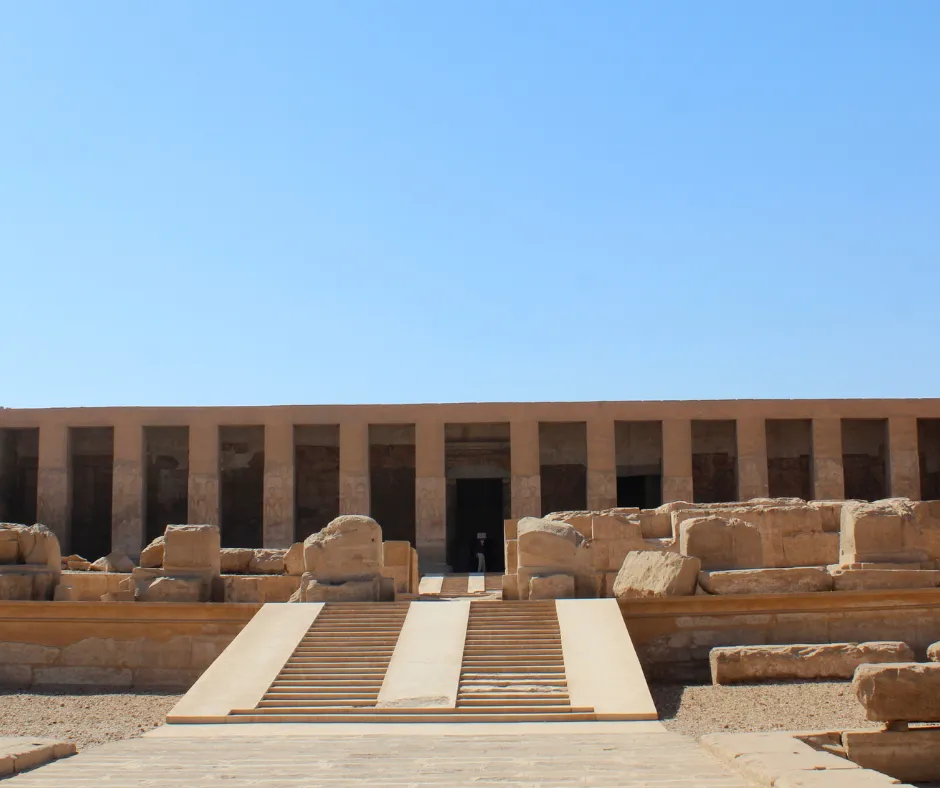
The Mortuary Temple of Seti I is, without a doubt, one of Egypt's most magnificent and well-preserved examples of New Kingdom architecture. Located in the ancient sacred city of Abydos north of the modern city of Luxor his 13th-century BCE masterpiece offers some of the most exquisite bas-relief carvings found anywhere in Egypt.
Dedicated to Pharaoh Seti I (the second ruler of the 19th Dynasty) and an array of major Egyptian gods, the temple complex is a journey into ancient religious practices, royal legitimacy, and legendary mysteries.
Where is Abydos?
Abydos is an ancient city in Upper Egypt, situated near the modern town of El-Balyana in the Sohag Governorate.
In ancient times, Abydos was one of the most important religious centers in Egypt.
Best Time to Visit and Opening Hours
Planning your trip carefully ensures you can explore the temple comfortably, away from the intense Egyptian heat and peak crowds.
Best Time of Year: The ideal time to visit Abydos is during the cooler months from October to April. The daytime temperatures are pleasant for exploring the open courtyards, though the interior of the temple provides some shade year-round.
Best Time of Day: Arrive as early as possible. The site is a popular excursion from Luxor, and early mornings offer beautiful lighting for photography, cooler temperatures, and fewer tour groups.
Opening Hours: The Temple of Seti I is generally open daily from 7:00 AM to 5:00 PM (hours may extend slightly during the summer months). Always check with a local guide or your tour operator for exact times, as schedules can shift during Ramadan or national holidays.
New History: A Monument to a Great Pharaoh
Built between 1290 and 1279 BCE during the New Kingdom, the temple was the crowning architectural achievement of Seti I.
Seti I initiated this grand temple to serve dual purposes: as his own mortuary temple where his cult would be maintained after his death, and as a massive sanctuary dedicated to the major gods of Egypt, prominently cementing his family's divine right to rule.
Why did Ramesses II finish the temple?
Seti I passed away before the temple was completely finished. His son, the famous Ramesses II (Ramesses the Great), took over the project.
A common misconception corrected: Some older sources mistakenly claim that the temple was built to honor Seti I as "the god of chaos." This is entirely false. While Seti's name means "He of Seth" (the god of chaos and storms), Seti I was a human pharaoh. Ramesses II finished the temple out of filial piety to honor his deceased father and to firmly link his own reign to Seti's legacy of restoring order and divine favor to Egypt.
The Unique Architecture of the Temple
Unlike standard Egyptian temples, which typically follow a straight linear axis, the Temple of Seti I has a highly unusual L-shaped layout.
The Courtyards
Approaching the temple, you pass through two large, open courtyards (mostly built by Ramesses II).
The First Courtyard: Much of this area is ruined today, but it originally served as the grand entrance.
The Second Courtyard: Features a colonnade and reliefs depicting Ramesses II making offerings and fighting in battles.
It serves as the transition point into the sacred, covered areas of the temple.
The Hypostyle Halls
The hypostyle halls of the Seti I temple are celebrated for their elegant proportions and the sheer quality of their relief carvings.
Fact Check: You may occasionally read that this temple contains 134 massive columns that actually describes the Great Hypostyle Hall at Karnak.
The Temple of Seti I is much more intimate.
The First Hypostyle Hall: Added by Ramesses II after his father's death, this hall contains 24 papyrus-bud columns arranged in 12 pairs.
The artwork here, while impressive, reflects the deeper, more hastily carved sunken relief style typical of Ramesses II's reign. The Second Hypostyle Hall: Built entirely under Seti I, this hall is an architectural marvel. It features 36 columns arranged in three rows.
The artwork here is executed in breathtaking raised relief. The walls vividly depict Seti I performing rituals before various gods, and the details in the carving down to the jewelry and fabric textures are considered some of the finest surviving art from the New Kingdom.
The Seven Chapels and the Osiris Sanctuary
Moving deeper into the temple from the Second Hypostyle Hall, the path diverges into seven distinct barque chapels.
These chapels were dedicated to:
The deified Seti I
Ptah (Creator god of Memphis)
Re-Horakhty (Sun god of Heliopolis)
Amun-Re (King of the gods from Thebes)
Osiris (God of the afterlife)
Isis (Wife of Osiris)
Horus (Son of Osiris and Isis)
The Osiris Sanctuary: The chapel of Osiris is unique because it doesn't end in a false door. Instead, it leads into a larger inner complex dedicated entirely to the Osiris cult, featuring halls and smaller chapels where rituals of death, mummification, and resurrection were symbolically enacted.
The Abydos King List: Rewriting History
Perhaps the most historically significant feature of the entire temple is found on a wall in a corridor leading to the temple's southern wing (the Slaughterhouse area).
Carved during the New Kingdom, this massive inscription features Seti I and his young son, Ramesses II, offering incense to the cartouches (name rings) of 76 past pharaohs of Egypt, spanning back 1,600 years to the very first king,
Why is it so important?
The list is a crucial tool that modern Egyptologists use to reconstruct the timeline of ancient Egypt.
Unraveling the Mysteries of Abydos
The "Helicopter Hieroglyphs"
One of the most viral mysteries surrounding the Temple of Seti I is the presence of carvings that appear to show a helicopter, a tank, and a submarine on a ceiling beam in the First Hypostyle Hall.
While these images have fueled countless ancient alien theories, the archaeological explanation is far more logical. These carvings are a palimpsest a case of ancient recycling.
Originally, the stone was carved with the titles of Seti I.
After Seti died, Ramesses II had his workers fill the original carvings with plaster and carve his own titles over the top.
Over thousands of years, the plaster fell out, causing the two overlapping sets of hieroglyphs to merge.
The resulting visual mashup coincidentally looks like modern machinery to our 21st-century eyes, a psychological phenomenon known as pareidolia.
Dorothy Eady (Omm Sety)
You cannot tell the modern story of the Seti I Temple without mentioning Dorothy Eady.
Eady moved to Egypt, became a respected Egyptologist, and eventually relocated permanently to Abydos in the 1950s. Known locally as "Omm Sety" (Mother of Sety), she spent decades living near the temple, performing ancient rituals, and assisting archaeologists. Her intimate, seemingly inexplicable knowledge of the temple's layout helped researchers locate the temple's ancient gardens and a hidden tunnel. Her story remains one of the most fascinating human connections to the site.
Frequently Asked Questions
Why is the Temple of Seti I important?
It is crucial for its unparalleled artistic quality (some of the finest bas-reliefs in Egypt), its unique seven-chapel architecture, and the Abydos King List, which is foundational to our understanding of Egyptian chronology.
Where was Seti I's tomb found?
His tomb was discovered in 1817 by Giovanni Battista Belzoni in the Valley of the Kings in Luxor. However, his mummy had been moved in antiquity to protect it from tomb robbers and was eventually discovered in the famous DB320 Royal Cache at Deir el-Bahari in 1881.
Was Seti I a real pharaoh?
Yes, he was a highly successful human ruler of the 19th Dynasty. Under his leadership, Egypt regained much of the territory and prestige lost during the turbulent Amarna period. His magnificent tomb (KV17) is one of the deepest and most beautifully decorated in the Valley of the Kings.
Conclusion
The Mortuary Temple of Seti I in Abydos is far more than just a footnote in ancient Egyptian history it is a masterclass in New Kingdom art, architecture, and religious devotion. Because it sits slightly off the primary tourist trail between Luxor and Aswan, those who make the journey are often rewarded with a quiet, deeply atmospheric experience that is increasingly rare at Egypt's major monuments.
Whether you are tracing the royal lineage on the legendary Abydos King List, marveling at the unparalleled raised reliefs in the hypostyle halls, or unraveling the modern-day mysteries of the "helicopter hieroglyphs" and Dorothy Eady, this site offers an incredibly rich narrative.
If you are planning an itinerary through Upper Egypt, taking a day trip north from Luxor to Abydos is an absolute must. Walking through the hallowed, shadow-filled corridors of Seti I’s masterpiece provides a profound, intimate connection to the pharaohs and gods of the ancient world, ensuring your trip to Egypt is truly unforgettable.