The Grand Egyptian Museum (GEM) is the largest archaeological museum in the world dedicated to ancient Egyptian civilization. Located just a few miles west of Cairo, near the iconic pyramids of Giza, Inside Grand Egyptian Museum holds over 100,000 artifacts spanning from prehistoric times to the Greco-Roman era. It is designed to showcase Egypt’s rich heritage with modern exhibition techniques and serve as a major cultural and tourist destination.
When Construction Began the Museum?
The idea of building the Grand Egyptian Museum emerged in the 1990s, with formal planning and studies beginning soon after. The cornerstone was laid in 2002 in a prime location overlooking the Giza pyramids. The international design competition was won by the Irish firm Heneghan Peng Architects, whose concept was inspired by the rays of sunlight hitting the three pyramids, forming a monumental triangular shape representing the museum. Construction started in May 2005 after site preparation, and the project involved global expertise in architecture, engineering, and museology.
Architectural Design for The Grand Egyptian Museum
The museum’s architecture covers over 300,000 square meters. Its unique triangular form is oriented to align with the pyramids’ axes, creating a symbolic connection to the ancient landscape. The building integrates advanced ventilation systems designed to maintain climate control necessary for preserving delicate artifacts. Large open spaces, glass facades, and natural lighting complement the environment, reducing reliance on artificial lighting and energy consumption.
Inside, the museum is divided into multiple halls and zones including permanent exhibition galleries, restoration labs, educational centers, conference halls, and commercial areas like shops and restaurants. The design carefully balances monumental grandeur with functional needs, offering visitors an immersive experience while attending to artifact conservation.
Explanation of Artifact Arrangement Inside Grand Egyptian Museum
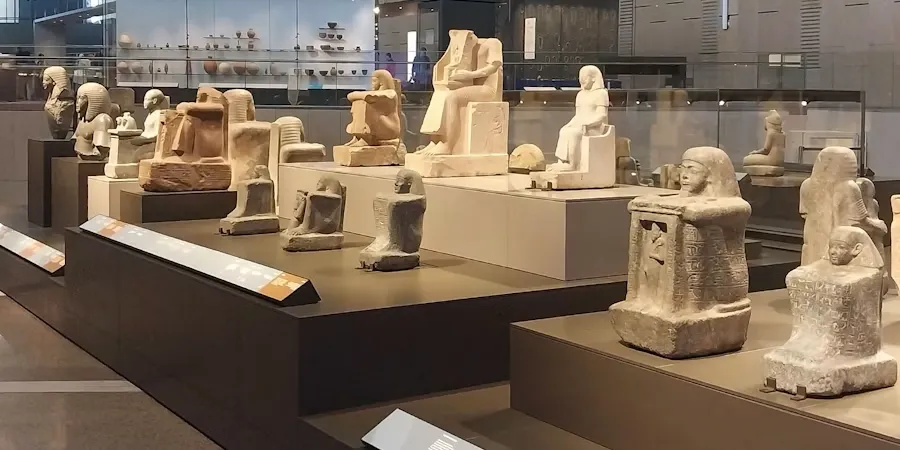
The artifact display within the Grand Egyptian Museum is organized mainly along a longitudinal axis resembling a linear path that guides visitors through historic periods and thematic groupings. This walking route allows a chronological and contextual understanding of ancient Egyptian history and culture. Visitors proceed progressively from early civilization artifacts to New Kingdom royal treasures, including the complete collection of king Tutankhamun treasure.
Some sections encourage lateral exploration with adjacent galleries dedicated to specific themes, such as funerary arts, jewelry, and monumental statues. The layout is intuitive, blending wide corridors and open spaces for viewing with smaller rooms for focused displays. This arrangement facilitates a fluid visitor experience, allowing a combination of guided tours and free exploration.
Conclusion
The Grand Egyptian Museum represents a new landmark in cultural heritage preservation and exhibition. It integrates cutting-edge architectural design with advanced museology to create a space where Egypt’s ancient legacy is preserved and celebrated on an unprecedented scale. Visitors to the museum experience a seamless journey through the millennia of Egyptian history, embodying both the grandeur of the past and the innovation of the present.