
Far from Egypt’s well-known pyramids and temples lies serabit el-khadim inscriptions , one of the most mysterious and isolated archaeological sites in the Sinai Peninsula. Perched atop a rugged mountain, this ancient temple complex dedicated to Hathor, the goddess of love and mining, reveals a lesser-known chapter in Egypt’s story.
Built during the Middle Kingdom (around 1900 BC), serabit el-khadim inscriptions was a hub for turquoise mining and spiritual rituals. Pharaohs sent expeditions here to extract precious stones and honor the deity believed to protect the miners.
Historical Importance of Sinai to the Pharaohs
Sinai held immense strategic and economic importance for the ancient Egyptian pharaohs due to its rich deposits of turquoise, copper, and gold. Numerous archaeological remains of mining operations can still be seen across the region. Near Abu Zenima, a road branches off toward Serabit el-Khadim, passing ancient manganese and turquoise mines that date back thousands of years.
The area was a key destination for royal mining expeditions, especially during the Middle Kingdom. Pharaohs from later dynasties erected numerous stelae at the site to commemorate their successful expeditions, many of which remain in place today.
Meaning and Significance of Serabit el-Khadim
The name Serabit el-Khadim carries symbolic meaning. “Serabit” refers to standing stones or stone tools, while “el-Khadim” means the servant or the guard. Together, the name reflects both the religious and functional role of the site.
The Temple of Serabit el-Khadim is considered the most important ancient Egyptian temple in the Sinai Peninsula. It represents the largest and oldest partially rock-cut temple in the region and was regarded as the most sacred sanctuary established by ancient miners anywhere in Egypt.
The Turquoise Mines of Sinai
The temple was built in an area once rich in turquoise, a highly valued semi-precious stone in ancient Egypt. While no turquoise remains today, archaeological evidence confirms extensive mining activity. The earliest traces date back to early periods, but a permanent Egyptian presence was established during the Middle Kingdom, particularly between 1790 and 1778 BC.
Pharaoh Senusert I developed an earlier rock-cut shrine known as the Cave of Hathor, where miners likely placed a statue of their patron goddess. Over time, a portico and open court were added, transforming the shrine into a full temple. Rocky paths led from the temple to nearby turquoise mines, and a residential area housed priests and workers. Inscriptions suggest that miners themselves sometimes served as volunteer priests.
Expeditions were organized every three to four years or annually during periods of high demand—and were led by senior officials who often held close ties to the royal court.
When was the Lost Cave of Hathor Discovered?
Hathor, known locally as “Lady of Turquoise,” was the patron goddess of miners. Along the rocky trails leading to the mines, workers carved graffiti of boats and hieroglyphic inscriptions invoking her protection. As mining activity expanded, the temple was repeatedly enlarged and decorated.
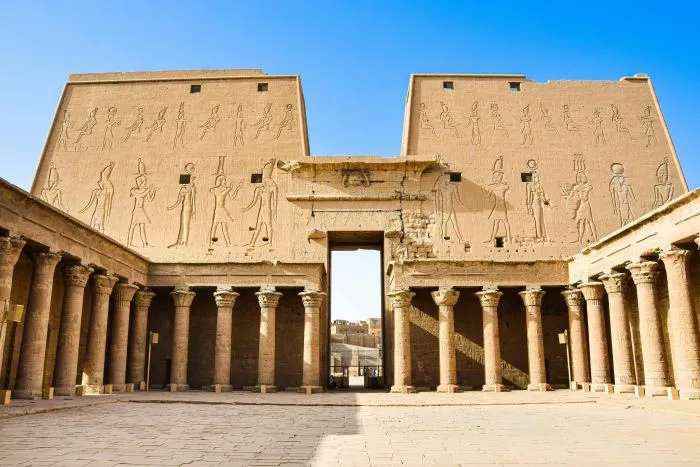
During the 18th Dynasty (around 1580 BC), the site flourished under the patronage of Queen Hatshepsut and Thutmose III. Barracks were expanded, and a new shrine dedicated to Sopd, god of the Eastern Desert, was added to the southern end. By this stage, the complex no longer resembled a traditional Egyptian temple, featuring open courts, pylons, and more than a dozen chambers supported by pillars.
Due to increasing tensions with local Bedouin tribes, an Egyptian military garrison was established to protect the miners. Records of confrontations and victories were carved into nearby rocks, often depicted in triumphal reliefs.
The Mines Around Serabit el-Khadim
Together with the now-destroyed mines of Wadi Maghara, the mines around Serabit el-Khadim were Egypt’s primary source of turquoise. Mining was extremely demanding. Workers crawled through narrow horizontal tunnels, often in unbearable heat.
A text from the reign of Amenemhat III describes the desert as “burning like summer, the mountain on fire,” yet confirms the success of the mission. When archaeologist Flinders Petrie studied the site in 1905, he removed many smaller stelae and statues for preservation, leaving the larger monuments in situ.
The Sinai Alphabet serabit el-khadim inscriptions
One of Serabit el-Khadim’s greatest contributions to world history is the discovery of the Sinai Alphabet. In 1905, Flinders Petrie identified 12 inscriptions containing previously unknown signs resembling hieroglyphs, dating to the reigns of Hatshepsut and Thutmose III. Later excavations increased the total to 25 inscriptions.
These symbols represent an early alphabetic system believed to have been created by Semitic workers in the turquoise mines around 1400 BC. Linguist Sir Alan Gardiner observed that several signs correspond to letter names found in Hebrew and Greek. One recurring inscription reads “Ba’alat,” meaning “the Mistress,” a Semitic title for the goddess Hathor. This discovery confirmed that the script was a cultural bridge between Egyptian and Semitic civilizations and is now recognized as the ancestor of the Phoenician alphabet, which later gave rise to the Greek alphabet.
What Makes serabit el-khadim inscriptions Special?
- Temple of Hathor: Built on a high plateau, it offers sweeping views and sacred remnants from the Middle and New Kingdoms.
- Inscriptions & Stelae: Dozens of hieroglyphic tablets and altars remain on site, telling stories of ancient expeditions.
- Proto-Sinaitic Script: Early alphabetic inscriptions were found here—believed to be a precursor to modern writing systems.
- Remote Adventure: Reaching the site involves a challenging hike with views over the Sinai desert—ideal for adventurous travelers.
- Surrounding Landscape: The area is dotted with ancient mine shafts and wild desert beauty, rarely seen by tourists.
How to Prepare for Your Visit to the Temple of Hathor
To ensure a safe and enriching journey to Serabit el-Khadim, consider these expert-vetted tips:
1. Hire a Local Bedouin Guide: This is non-negotiable. The trail to the Temple of Hathor and the ancient turquoise mines is unmarked and rugged. Only local Bedouin guides possess the deep knowledge of the terrain and the cultural history of the South Sinai mountains.
2. Best Time to Visit: The ideal window is from October to April. During these months, the daytime temperatures are perfect for the 1.5 to 2-hour uphill hike. Avoid mid-summer, as the heat in the Sinai desert can be extreme and dangerous for hiking.
3. Physical Preparation: The hike to the summit is moderately challenging. Ensure you are wearing high-quality hiking boots with good grip, as the path involves climbing over sandstone and rocky terrain.
4. Packing Essentials: * Water: Carry at least 3 liters of water per person.
Sun Protection: High-SPF sunscreen, a wide-brimmed hat, and polarized sunglasses are mandatory.
Layers: Even in spring, the mountain wind can be chilly; bring a lightweight windbreaker.
5. Respect the Heritage: Serabit el-Khadim is home to the world’s first alphabet (Proto-Sinaitic). Avoid touching the inscriptions or the ancient stelae, as the sandstone is fragile and easily damaged by skin oils.
6. Connectivity & Safety: Expect zero mobile signal at the site. Always inform your hotel or a local contact of your expected return time. If you are planning an overnight desert camping experience, ensure your tour operator provides all necessary gear for the cold desert nights.
Discover serabit el-khadim inscriptions with Desert Cruise Travel
Desert Cruise Travel offers custom day trips and multi-day expeditions to serabit el-khadim inscriptions for travelers seeking Egypt’s hidden sacred sites. Explore with professional guides, safe transport, and the insight of Egypt’s spiritual landscapes.
✅ Guided hikes & history tours
✅ Bedouin escort & support
✅ Add-ons to Dahab, St. Catherine, or Nuweiba
✅ Transportation from Sinai hubs
Conclusion A Temple Lost in Time
Serabit el-Khadim is a treasure of Egyptian history and spiritual tradition—hidden above the desert, far from the tourist crowds. If you’re ready to go beyond the usual and uncover the ancient mystery of Sinai, this is a journey worth taking.
Book your Serabit el-Khadim tour with Desert Cruise Travel and step into Egypt’s forgotten mountain shrine.