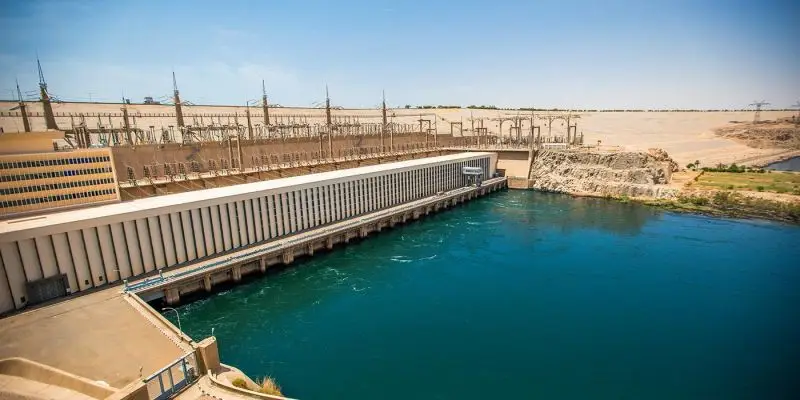
The Aswan High Dam stands as a monumental achievement of modern Egypt, embodying the nation’s leap into the industrial era. Completed in 1970 with crucial Soviet support, this engineering wonder harnesses the Nile’s power, preventing devastating floods, forming vast Lake Nasser, and generating nearly half of Egypt’s electricity. While it revolutionized agriculture, industry, and tourism, the Aswan High Dam also sparked global efforts to save ancient treasures like Abu Simbel from submersion.
Location Aswan High Dam
Located just 13 km south of Aswan city, the Aswan High Dam spans the Nile at its narrowest point near the First Cataract. Rising 111 meters high, stretching 3,830 meters long, and 980 meters wide at the base, it holds back immense volumes of water—up to 43 million cubic meters of materials in its structure alone. Its 12 Francis turbines produce 2,100 MW of hydroelectric power, fueling homes and factories nationwide.
Architectural Design of the Aswan High Dam
The Aswan High Dam showcases innovative rock-fill dam architecture, a design chosen for the Nile’s granite bedrock and seismic stability. Unlike concrete gravity dams, it features a central clay core impermeable to water, flanked by 44 million cubic meters of compacted earth, rock, and sand from nearby quarries. The saddle-shaped crest curves gracefully over 3,830 meters, with a downstream face sloping at 1:1.85 for stability.
Key architectural highlights include:
Granite Curb Wall: A 40-meter-high, 4-meter-thick barrier along the downstream toe to prevent seepage and erosion.
Spillway and Turbines: A 6,400-meter auxiliary spillway handles excess floods, while the powerhouse integrates six intake towers feeding 175 MW turbines each.
Monumental Elements: Flanked by statues of ancient pharaohs and modern obelisks, blending Egyptian heritage with Soviet engineering—symbolizing continuity from Nile antiquity to 20th-century progress.
A Storied Path to Construction
Efforts to tame the Nile date back centuries. In the 9th century, during Fatimid Caliph Al-Hakim’s reign, engineer Ibn al-Haytham proposed a dam but failed. King Farouk commissioned Greek-Egyptian Adrian Daninos in 1912, yet the project stalled. Post-1952 revolution, President Gamal Abdel Nasser pushed forward despite Western refusals, securing Soviet funding at $1.12 billion. Construction began January 9, 1960, wrapping up in spring 1971, employing 34,000 workers.
The result? Lake Nasser, one of the world’s largest man-made lakes at 5,250 sq km, storing 132 cubic km of water for irrigating 33,600 km of land.
Challenges of the Aswan High Dam
No project this grand is without trade-offs. The Aswan High Dam displaced 50,000 Nubians to New Nubia (45 km from Aswan) and altered ecosystems, promoting schistosomiasis, changing fish populations, soil salinity, and Nile sedimentation. Yet, UNESCO’s heroic rescue of 22 monuments, including Abu Simbel and Philae Temple relocated block-by-block preserved irreplaceable heritage.
Transformative Benefits of the Aswan High Dam
The Aswan High Dam delivers multifaceted advantages:
Flood Control and Irrigation: Ends annual Nile floods, enabling year-round farming and protecting against droughts for 500,000 families.
Electricity Generation: Supplies up to 50% of Egypt’s power, sparking industrial growth and urban development.
Economic Boost: Reclaims desert land, enhances navigation, and fuels tourism via Nile cruises.
Strategic Water Management: Lake Nasser’s reserves ensure stability amid population growth.
Near the Aswan High Dam, visitors enjoy panoramic views, boat rides, and insights into Egypt’s modernization a symbol of the 1952 revolution’s enduring legacy.
Add Your Heading Text Here
The Aswan High Dam remains an eternal symbol of Egyptian achievement, masterfully uniting the ancient power of the Nile with modern engineering to reshape history. From its monumental agricultural and industrial benefits to the environmental challenges Egypt overcame, the dam offers an extraordinary tourism experience that transcends concrete walls through enchanting Desert Cruise Travel.