
Travel Guide
The Great Pyramid of Khufu: Decoding the Enigma of the Ancient World
14 min read
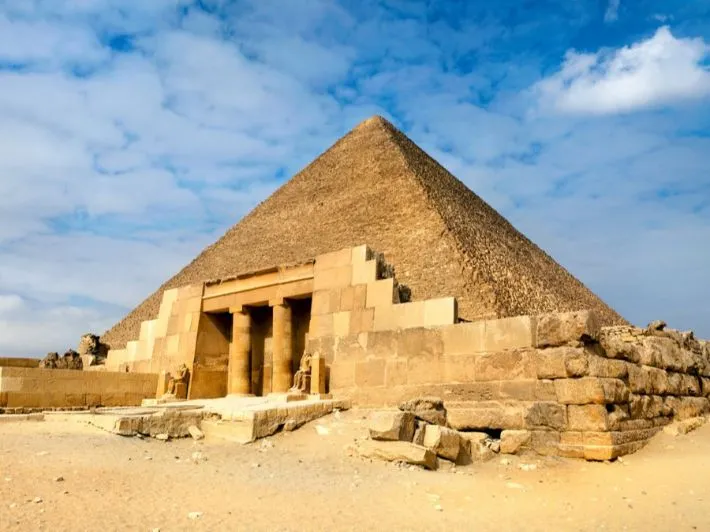
For over 4,500 years, the Giza Plateau has been dominated by a structure that defies time, logic, and the limitations of its era. Standing as the last remaining wonder of the ancient world, The Great Pyramid of Khufu continues to cast a long shadow over modern history, engineering, and archaeology. But what is it about this mountain of stone that captivates the human imagination generation after generation? Is it merely a royal tomb, or does it hold deeper secrets of a lost technological prowess? In this comprehensive exploration, we peel back the layers of history to uncover the truth behind the world’s most enigmatic monument.
Why Does The Great Pyramid of Khufu Still Fascinate Us Today?
The fascination with the Great Pyramid is not accidental; it is rooted in its sheer scale and precision. As the centerpiece of the Giza necropolis, it represents the pinnacle of Old Kingdom architectural ambition. While thousands of years of erosion and human activity have stripped away its smooth Tura limestone casing, the core structure remains a testament to the organizational brilliance of the ancient Egyptians. In a world of modern skyscrapers, the Pyramid remains a benchmark for precision, aligning almost perfectly with true north and utilizing mathematical constants that researchers are still debating to this day.
How Did Ancient Engineers Realize Such a Monumental Vision?
To truly appreciate The Great Pyramid of Khufu, one must look beyond its facade and into the logistics of its creation. How were 2.3 million stone blocks, some weighing several tons, transported from quarries and hoisted to such breathtaking heights? Was it the labor of a massive, organized workforce, or the application of innovative hydraulic and mechanical systems that history has yet to fully acknowledge? By examining the physical evidence, we move away from myths of magic and toward a grounded understanding of ancient Egyptian engineering, labor management, and the indomitable spirit of a civilization that built for eternity.
Who Was the Architect Behind the Great Pyramid of Khufu?
To understand the scale of the Great Pyramid, one must first look at the man behind the ambition: Pharaoh Khufu (known to the Greeks as Cheops). Ruling during the Fourth Dynasty of the Old Kingdom, Khufu inherited a legacy of monumental building from his father, Sneferu, who had mastered the transition from the Step Pyramid to the "True" Pyramid. But why did Khufu decide to push the boundaries of engineering to such an unprecedented extreme? Historians view his reign as a period of absolute administrative control, where the pharaoh’s power was so consolidated that he could mobilize the vast resources of the Nile Valley to realize a project that would define his divinity for eternity.
Why Was the Giza Plateau Chosen for This Eternal Resting Place?
When Khufu surveyed the horizon for his final home, he did not choose at random. The Giza Plateau provided a solid limestone bedrock foundation capable of supporting the six-million-ton mass of The Great Pyramid of Khufu. But there was a deeper, symbolic purpose. The site sits on the west bank of the Nile, the traditional land of the dead, yet it is perfectly positioned in relation to the rising and setting sun. By choosing this location, the architects ensured that the monument would serve as a bridge between the terrestrial world of the living and the celestial realm of the gods, acting as a massive anchor point for the pharaoh's soul to ascend into the sky.
What Does the Construction Timeline Tell Us About the Old Kingdom?
The construction of the Great Pyramid is often shrouded in myths of slave labor and mystical origins, but the archaeological evidence paints a very different picture of the Fourth Dynasty. How long did it really take to manifest this vision? Evidence from the "Diary of Merer". a logbook found at the port of Wadi al-Jarf suggests that the project unfolded over the roughly 20-year reign of Khufu. This timeframe implies an incredibly sophisticated logistical operation. It required not just a massive workforce of skilled laborers, who were well-fed and organized into hierarchical guilds, but a national infrastructure of agriculture and river transport to sustain them. This feat stands as perhaps the most significant achievement of the Old Kingdom, proving that the Egyptian state was one of the most organized bureaucracies in the ancient world.
How Did Ancient Engineers Achieve Such Unprecedented Precision?
The construction of The Great Pyramid of Khufu remains a subject of intense debate among structural engineers and archaeologists. How did a Bronze Age civilization, working without iron tools, pulleys, or wheels as we know them, align a structure with 6.5 million tons of mass to true north with an accuracy of within three-sixtieths of a degree? This level of precision suggests that the ancient Egyptians possessed a sophisticated grasp of astronomy and surveying. By observing the rotation of stars around the celestial pole, they established a foundation so stable that, despite seismic activity over four millennia, the base remains remarkably level.
Where Did the Massive Materials Come From?
The sheer volume of material required for the project is staggering. Where did they source the raw components, and how did they manage the supply chain? The internal core of the pyramid consists primarily of local yellow limestone quarried directly from the Giza plateau. However, the external casing was composed of fine, white Tura limestone, which once gave the pyramid a brilliant, reflective sheen. Perhaps most impressive are the massive granite beams used in the King’s Chamber some weighing up to 80 tons. which were transported over 800 kilometers from Aswan. This logistical feat required the mobilization of a massive fleet of barges during the Nile’s annual flood, demonstrating a mastery of hydro-engineering and river transport that supported the construction process.
What Was the Secret Behind the Ramp Systems?
The central mystery that has occupied researchers for centuries is: how exactly were these enormous blocks lifted? While traditional theories long favored a massive, straight external ramp, recent engineering simulations suggest this would have required more material than the pyramid itself. Could the solution have been a spiral ramp, winding around the exterior? Or perhaps an internal, vaulted ramp system that allowed for the construction of the upper levels from within? The prevailing modern consensus suggests a combination of methods. likely utilizing shorter, angled ramps on the exterior, potentially supplemented by a system of levers and counterweights. This blend of simple physics and massive human labor highlights that the "miracle" was not just a single invention, but a complex, evolving system of logistics that optimized work as the structure rose toward the sky.
How Is the Internal Architecture Designed to Defy Time?
When one ventures inside The Great Pyramid of Khufu, the true genius of the Old Kingdom architects becomes apparent. Unlike earlier pyramids that were relatively solid, the Great Pyramid is a labyrinth of internal corridors and chambers designed with specific functional and symbolic purposes. But how did they manage to support such immense weight? The architects employed a brilliant system of load-bearing architecture, utilizing "relieving chambers" above the main burial space. These layers of massive stone beams were designed to divert the crushing weight of the millions of tons of masonry above, preventing the ceiling of the King's Chamber from collapsing under the extreme pressure of the structure.
What Secrets Lie Within the King’s and Queen’s Chambers?
The heart of the pyramid holds the King’s Chamber, a room constructed entirely of red granite, showcasing some of the most impressive masonry in the ancient world. But why are there two distinct chambers often referred to as the "King’s" and "Queen’s" rooms? While traditional Egyptology identifies these as burial and ceremonial spaces, their function remains a subject of intense academic debate. These rooms are connected by narrow "air shafts" that point toward specific constellations in the night sky. Were these shafts meant for ventilation, or were they symbolic "star tunnels" designed to facilitate the pharaoh’s soul on its journey to the celestial afterlife?
What Is the Purpose of the Grand Gallery?
Perhaps the most awe-inspiring feature of the interior is the Grand Gallery. This soaring, corbelled passage is a feat of architectural beauty that defies the cramped expectations one might have of an ancient tomb. Its seven-stepped walls rise to a height of nearly 9 meters, creating an acoustic and spatial experience unlike any other structure from antiquity. What was the purpose of such a grand and elongated space? Some theories suggest it served a structural role in housing the massive stone plugs used to seal the burial chamber, while others argue its dimensions were calibrated to align with specific astronomical cycles. Regardless of its exact intent, the Grand Gallery remains a masterpiece of precision engineering, standing as a testament to the sophistication of Khufu’s royal architects.
What Scientific Methods Are Used to Reveal Hidden Secrets?
In an era of advanced technology, scientists are no longer limited to physical exploration. How are we uncovering the voids that have remained untouched for millennia? The most groundbreaking development in recent years is the ScanPyramids project, which utilizes muon tomography. Muons are cosmic ray particles that pass through stone but are absorbed or deflected by voids. By placing detectors inside and outside The Great Pyramid of Khufu, researchers have been able to "X-ray" the structure, leading to the sensational discovery of a large, previously unknown hollow space—a "Big Void"—located above the Grand Gallery. This proves that despite thousands of years of study, the pyramid still holds secrets waiting to be mapped by modern physics.
Do the Pyramid’s Dimensions Contain Mathematical Constants?
One of the most enduring debates concerns the mathematical precision of the monument. Is it possible that the ancient Egyptians encoded advanced mathematical concepts into the very geometry of the pyramid? Some researchers argue that the ratio of the pyramid's perimeter to its height approximates $2\pi$, while others point to the presence of the Golden Ratio ($\phi$) in its proportions. While mainstream Egyptologists caution against attributing modern mathematical concepts to the ancient builders, the intentionality behind the measurements is undeniable. Whether these ratios were the result of a sophisticated geometric philosophy or a byproduct of their measurement systems, they continue to fuel the debate on how much astronomical and mathematical knowledge was truly possessed by the Old Kingdom architects.
Are the "Star Shafts" Proof of Celestial Alignment?
Beyond the physical structure, there is a strong argument that the pyramid functions as a massive, stone-bound star map. Why do the narrow shafts extending from the King’s and Queen’s chambers point toward specific regions of the sky? In the ancient Egyptian belief system, the North Star and the constellation of Orion were intrinsically linked to the concepts of resurrection and the afterlife. By aligning these shafts with the meridian transits of specific stars, the architects may have created a "launchpad" for the pharaoh’s soul. This suggests that The Great Pyramid of Khufu was never intended to be merely a static tomb, but an active, functional machine designed to interact with the cosmos itself.
Is the "Power Plant" Theory Supported by Science?
The mystery of the pyramid has inevitably led to alternative, sometimes fringe, theories. One of the most famous is the "Giza Power Plant" hypothesis, which suggests that the internal layout—the granite chambers, the conductive minerals in the stone, and the acoustic properties of the structure could have functioned as an ancient generator. While there is no empirical evidence to support the idea that the pyramid generated electricity in the modern sense, the theory highlights how the pyramid's unique physical properties. its mass, its geological location on a limestone plateau, and its precise internal geometry continue to provoke curiosity. Science continues to investigate the structure, filtering out the sensationalist myths while respecting the genuine technological brilliance required to create a monument that has survived the rise and fall of countless civilizations.
How Has The Great Pyramid of Khufu Shaped Global Culture?
For millennia, The Great Pyramid of Khufu has transcended its original role as a royal tomb to become a universal symbol of human ambition and endurance. How did this ancient monument influence the collective consciousness of civilizations long after the fall of the Pharaohs? From the Hellenistic period, when Greek scholars first designated it as the first of the Seven Wonders of the Ancient World, to the modern era, the pyramid has served as the ultimate canvas for human wonder. It has inspired countless poets, painters, and philosophers, representing the eternal struggle between the human desire for immortality and the relentless passage of time.
Why Is It a Corner-Stone of Modern Heritage and Tourism?
The significance of the pyramid extends far beyond history books, anchoring itself firmly in the modern identity of Egypt and global heritage. As a UNESCO World Heritage site, it is not merely an object of study but a center of cultural preservation. How does the preservation of such a massive monument affect our understanding of global tourism today? The Giza Plateau stands as one of the most visited locations on Earth, bridging the gap between the ancient world and the modern traveler. Its presence serves as a constant reminder of the importance of maintaining historical integrity in the face of rapid urbanization and the pressures of mass tourism.
What Legacy Has the Pyramid Left for Architecture and Art?
Beyond its historical and cultural weight, the architectural influence of the Great Pyramid is inescapable. How has the geometric purity of the pyramid influenced modern design? From the glass-and-steel pyramids of the Louvre in Paris to the various modern structures that adopt the pyramid’s silhouette, the shape remains an iconic shorthand for strength, stability, and historical weight. The pyramid has also permeated global media, from films and literature to video games, solidifying its place in popular culture as the ultimate "enigma of the past." It remains the benchmark against which all other man-made structures are measured, a testament to the fact that when humanity unites under a singular, focused vision, we are capable of creating things that genuinely defy the centuries.
What Should You Know Before Visiting The Great Pyramid of Khufu?
Timing is Everything: Arrive as early as possible (ideally at the 8:00 AM opening time) to escape the intense midday desert heat and avoid the largest crowds of tour groups.
Ticket Strategy: Remember that entry to the interior of the pyramid requires a separate, limited-availability ticket; it is best to purchase these online in advance or immediately upon reaching the gate.
Best Views: For iconic photographs that capture all three main pyramids in one frame, head directly to the "Panoramic Point" located on the western ridge of the plateau.
Comfort and Protection: Wear sturdy, comfortable footwear to navigate the uneven limestone terrain, and ensure you have a wide-brimmed hat, sunglasses, and high-SPF sunscreen.
Hydration: Shade is extremely scarce across the plateau; carry plenty of water and stay hydrated throughout your exploration.
Official Guidance: Engage only with authorized guides or official personnel to navigate the site effectively and avoid unsolicited vendors.
Respect the Heritage: Adhere strictly to all site regulations regarding photography and physical contact with the masonry, as these rules are vital for the long-term preservation of this irreplaceable wonder.
Frequently Asked Questions
Could aliens have built the pyramids?
There is no scientific evidence to support extraterrestrial involvement. The Great Pyramid is a clear product of ancient Egyptian evolutionary architectural progress, reflecting centuries of experimentation, mathematical refinement, and sophisticated organizational capability.
How much does the Great Pyramid weigh?
Engineers and geologists estimate that the total weight of the Great Pyramid is approximately 6 million tons, consisting of about 2.3 million individual stone blocks.
Was The Great Pyramid of Khufu built by slaves?
Modern archaeological evidence, including the discovery of workers' cemeteries and logs like the "Diary of Merer," indicates that the pyramid was built by a massive, organized, and well-fed workforce of skilled Egyptian citizens, not slaves.
conclusion
In conclusion, The Great Pyramid of Khufu remains far more than a monument of stone; it is a profound testament to human ingenuity, ambition, and the relentless quest for immortality. From its impeccable astronomical alignment to the logistical mastery required for its construction, the pyramid continues to challenge our understanding of what an ancient civilization could achieve. While modern science and new discovery methods like muon tomography continue to peel back its layers of mystery, the structure itself stands as an eternal bridge between our past and present. It invites every generation to question, to explore, and to marvel at the sheer scale of what humanity can build when inspired by a singular, transcendent vision.