Kalabsha Temple is one of Aswan’s most tranquil and remarkable ancient monuments, gracefully positioned on the western bank of the Nile, close to the modern Aswan High Dam. Constructed around 30 BCE during the early Roman era under Emperor Augustus, this temple was dedicated to Mandulis, the Nubian sun god. Its unique artistic fusion of Egyptian and Roman styles makes it one of the best-preserved and grandest temples of Nubia, offering visitors a glimpse into the spiritual and architectural brilliance of the region.
The temple is not only a place of worship but also a historical record of Nubia’s cultural and religious evolution. From its original construction in the late Ptolemaic period to its careful relocation in the 20th century, Kalabsha Temple remains a testament to human ingenuity, religious devotion, and the rich heritage of southern Egypt.
History of Kalabsha Temple
Built during the late Ptolemaic period and completed under Roman rule, Kalabsha Temple rests on the site of an earlier sanctuary dating back to Egypt’s 18th Dynasty, linked to Pharaohs like Amenhotep II. While the temple was never fully completed, its surviving reliefs display intricate depictions of gods, pharaohs, rituals, and community life.
One of the temple’s most fascinating aspects is its historical inscriptions. Some walls prohibit pigs from entering the sacred spaces, while others commemorate the military victories of Nubian King Silko, highlighting the temple’s role not just as a religious site, but also as a cultural and political landmark.
During the 1960s, the construction of the Aswan High Dam posed a severe threat of flooding to many Nubian monuments, including Kalabsha Temple. To preserve this architectural treasure, it was meticulously dismantled and moved to New Kalabsha Island, demonstrating an extraordinary feat of modern engineering. This relocation preserved the temple’s intricate reliefs, statues, and structural integrity, allowing future generations to experience its grandeur.
In the 1960s, to protect the temple from the flooding caused by the construction of the Aswan High Dam, it was meticulously dismantled and relocated to its current location on New Kalabsha Island. This remarkable feat of modern engineering ensured the preservation of one of Nubia’s finest architectural treasures, making it accessible to future generations and scholars alike.
Location and Why It’s Named Kalabsha Temple
Kalabsha Temple is located approximately 50 kilometers south of Aswan, near the shores of Lake Nasser. The temple was originally situated on Kalabsha Island, from which it derives its name. The word “Kalabsha” is rooted in the local Nubian language, reflecting the area’s deep cultural heritage. Today, visitors can access Kalabsha Temple on New Kalabsha Island, where it stands as a serene and slightly less crowded alternative to more famous Aswan sites.
Its location along the Nile has long been strategic. In antiquity, it formed part of the network of temples, fortresses, and trade routes linking Egypt to Nubia, facilitating commerce, cultural exchange, and military operations. Today, the setting offers visitors sweeping views of the Nile, desert horizons, and a calm, reflective atmosphere perfect for exploration.
Purpose of the Temple
The primary purpose of Kalabsha Temple was to honor Mandulis, the Nubian sun deity associated with protection and fertility. Mandulis was worshipped widely in Nubia, and the temple served as a focal point for rituals meant to ensure the prosperity and safety of local communities.
In addition, the temple included shrines dedicated to the Egyptian gods Isis and Osiris, reflecting a harmonious blending of Egyptian and Nubian religious traditions. The presence of multiple deities within the temple complex illustrates the cosmopolitan and integrative nature of religious practices in southern Egypt during the Ptolemaic and Roman periods.
The temple also served as a place for community gatherings, spiritual education, and ceremonies marking agricultural and solar events. Its central role in both Nubian and Egyptian society emphasizes how Kalabsha Temple was much more than a religious site—it was a hub of cultural identity and political expression.
Architectural Features and Interior Layout
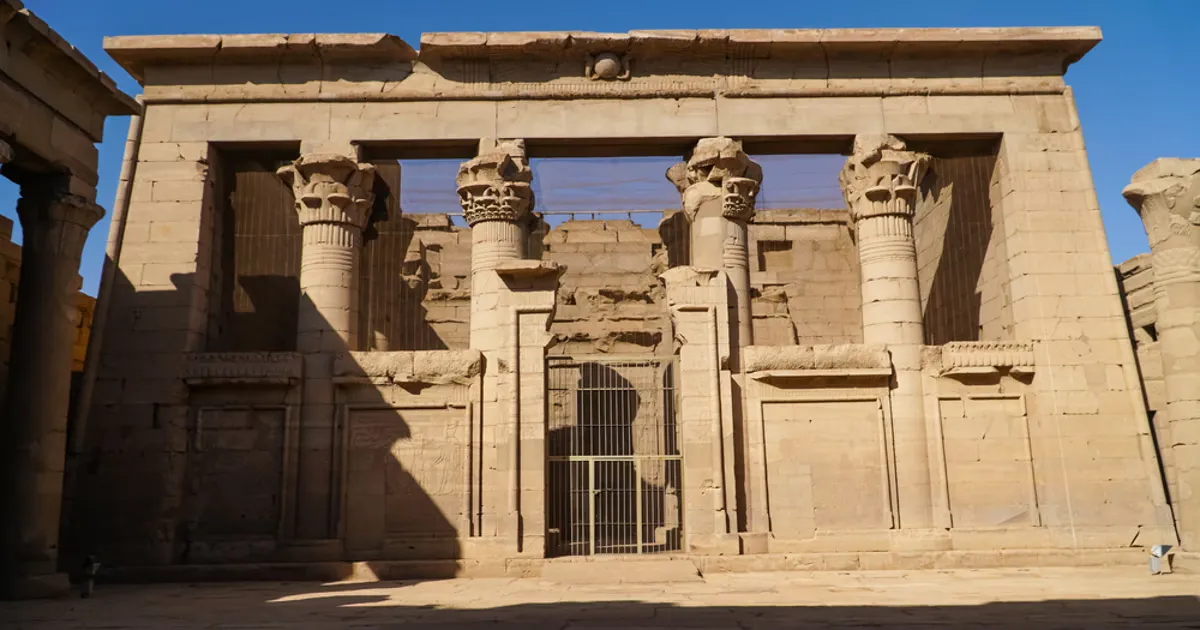
Kalabsha Temple is a fine example of classical Ptolemaic temple architecture, enhanced by Roman influences. Key architectural features include:
Monumental Gateway (Pylon): Visitors enter through a towering pylon that leads into an open-air forecourt. This impressive entrance sets the tone for the grandeur within.
Colonnaded or Hypostyle Hall: A vast hall supported by slender, intricately carved columns, decorated with detailed reliefs depicting gods, pharaohs, and ritual scenes.
Offering Halls: Two transversal chambers served as spaces for presenting offerings to the gods.
Sanctuary of Mandulis: The central sanctuary housed the cult image of Mandulis, where priests conducted daily rituals.
Additional Chapels: Smaller chapels, including one dedicated to the Nubian god Dedwen, highlight the temple’s religious diversity.
The temple’s design demonstrates a blend of Egyptian tradition with Greco-Roman elements, visible in column styles, spatial layout, and decorative motifs. A staircase allows visitors to climb from the sanctuary to the roof, offering panoramic views of the temple complex, the Nile, and the surrounding desert landscape—a perfect spot for photography and reflection.
Cultural and Historical Significance
Kalabsha Temple reflects a fascinating period in Nubian and Egyptian history. Its walls contain Meroitic and Greek inscriptions, providing valuable insight into the multicultural interactions that shaped the region. The temple’s later adaptation as a Christian church, evidenced by crosses carved into its stones, shows how sacred sites evolved to meet the spiritual needs of changing populations.
One of the temple’s most notable achievements is its successful relocation in the 1960s. It was the largest freestanding temple ever moved to save it from the waters of Lake Nasser caused by the Aswan High Dam. This monumental project ensured that Kalabsha Temple remained accessible to scholars, historians, and tourists, preserving its spiritual and architectural legacy.
Visiting Kalabsha Temple Today
Modern visitors to Kalabsha Temple can enjoy an immersive experience exploring its peaceful courtyards, elaborate reliefs, and sacred chambers. The serene setting, away from the crowds of central Aswan, allows travelers to reflect on the temple’s rich history and the civilizations that shaped it.
Highlights for visitors include:
Admiring the reliefs depicting pharaohs, gods, and Nubian kings.
Observing the harmonious mix of Egyptian and Roman architectural styles.
Climbing the sanctuary staircase for stunning views of Lake Nasser.
Understanding Nubia’s historical and religious significance through inscriptions and temple design.
Experiencing the spiritual atmosphere where ancient rituals once took place.
Kalabsha Temple is also easily combined with visits to other Aswan sites, such as Philae Temple, Elephantine Island, and the Aswan High Dam, making it a key highlight for anyone exploring southern Egypt.
Fascinating Facts About Kalabsha Temple
The temple’s walls include prohibitions and historical records, like restrictions on animals and accounts of royal victories.
It contains Meroitic and Greek inscriptions, reflecting Nubia’s diverse cultural heritage.
Christian crosses carved into stone show the temple’s later adaptation as a church.
The temple’s relocation during the 1960s was part of the UNESCO-led initiative to save Nubia’s heritage.
Kalabsha Temple remains one of the most peaceful and architecturally impressive temples in Aswan, offering visitors an authentic glimpse into Nubia’s spiritual past.
Conclusion
Kalabsha Temple stands as a tranquil monument embodying the spiritual and architectural brilliance of Nubia, preserved against natural threats by modern engineering. Visitors to Aswan can explore its peaceful courtyards and richly decorated halls to connect with a layered history that spans ancient Egypt, Nubia, Rome, and early Christianity.